| March, 2008 |  |
< Prev Page 6 Next > |
German travel agency to offer nudist flight
German nudists will be able to start their holidays early by stripping off on the plane if they take up a new offer from an eastern German travel firm. Travel agency OssiUrlaub.de said it would start taking bookings from (today) for a trial nudist day trip from the eastern German town of Erfurt to the popular Baltic Sea resort of Usedom, planned for July 5 and costing $735. ‘It’s expensive, I know,’ managing director Enrico Hess told Reuters by phone. ‘It’s because the plane’s very small. There’s no real reason why a flight in which one flies naked should be more expensive than any other.’ The 55 passengers will have to remain clothed until they board, and dress before disembarking, said Hess. The crew will remain clothed throughout the flight for safety reasons.
Swedish study methane from burping cows
A Swedish university has received 3.8 million kronor ($590,000) in research funds to measure the greenhouse gases released when cows belch.
About 20 cows will participate in the project run by the Swedish University for Agricultural Sciences in Uppsala, about 40 miles north of Stockholm, officials said Monday.
Cattle release methane, a greenhouse gas believed to contribute to global warming, when they digest their food. Researchers believe the level of methane released depends on the type of food the eat.
Project leader Jan Bertilsson said that the cows involved in the study will have different diets and wear a collar device measuring the methane level in the air around them. Bertilsson said 95% of the methane released by cows comes out through the mouth.
“This type of research is already being conducted in Canada so we will be in contact with Canadian agricultural researchers in the near future,” he said.
The research will be funded by a grant from the government’s Swedish Research Council for Environment, Agricultural Sciences and Spatial Planning.
Snakes on a plane – really!
Vietnamese authorities seized more than a ton of snakes that were smuggled into the country on a Vietnam Airlines flight from Thailand. The Associated Press says “thousands of non-venomous rat snakes” were sent on the flight as cargo. The 60 boxes of snakes had been declared as live fish. AP says “many of the snakes, which were surrounded by plastic filled with ice water, died,” according to local officials. It’s also not the first time that Vietnamese authorities have had to deal with snakes. Last month, they found more than 1,540 pounds of dead snakes on a Thai Airways flight. Vietnam Airlines spokesman Trinh Ngoc Thanh says he suspects a problem with cargo inspection at Bangkok. “We plan to send a letter to the Bangkok airport authorities urging them to enhance inspection to avoid this incident from happening again,” Thanh tells AP.
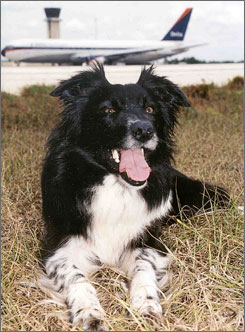 Dog has a ruff job at Florida airport
Southwest Florida International relies on an old-fashioned remedy for runway safety: a smart dog.
Since 2001, a 9-year-old border collie named Radar has been patrolling the runway and chasing away any birds in sight. Birds being sucked into aircraft engines is one of the most persistent safety problems at airports. Border collies scare the birds but don't harm them.
The military was first to use dogs to chase birds from runways. Southwest Florida was the first commercial airport to begin using dogs in 1999, says airport spokeswoman Victoria Moreland.
She says other airports have inquired about it, and some are adopting the program.
She says bird strikes and bird populations have fallen dramatically. Surrounded by lakes and wetlands, the airport draws a variety of species, including sandhill cranes, eagles, wood storks, turkey vultures, egrets, herons and ducks.
The Federal Aviation Administration has asked airports to update wildlife management programs. Other airports have used fake owls, firecrackers and propane cannons to deter birds.
| March, 2008 | |
< Prev Page 6 Next > |